 Cuis Smalltalk
Community
Mailing list, monthly meetings and how to contribute.
Cuis has an active community of developers and users. Our main meeting point is the mailing list. You are welcome in our community! If you use Cuis or are curious about our work, subscribe to the mailing list to ask questions and tell us about your own projects and ideas. Please take a look at Getting help with Cuis.
You can browse the archives for a glimpse of previous discussions. Before April 2019, we used cuis-dev@cuis-smalltalk.org: zip with messages. Before April 2016, we used cuis@jvuletich.org: archives.
Cuis is maintained on its main GitHub repo. All source code, the issue tracker and documentation are held there. The latest changes to Cuis Smalltalk can be browsed in the Core updates commits.
Share your ideas
We especially value public discussion of ideas. Do you think we should be doing something in a different way? Git integration? Automatic discovery of remote git repositories? Source code format? Modularization? Any others?
Public discussion of ideas and public sharing of your experiments and sketches is the way to move forward. Your ideas will be enriched by others, and you’ll find helping hands.
Keeping them to yourself for too long may mean they never mature. Sharing them privately only with project maintainers may not give the result you expect. We will pay more attention and give deeper consideration to public discussion than to private discussion. Why? Because public discussion will benefit the whole community and project, while private discussion will most likely only benefit you. So, please, don’t be shy and help others by engaging in public discussion of ideas.
Contributing to Cuis
For the recommended way of handling your own projects based on Cuis, please read Code Management in Cuis, about developing packages for Cuis, and Using Git and GitHub to host and manage Cuis code. While Cuis should work equally well with any file-based DVCS, we encourage the use of Git and GitHub.
To contribute code to the base image, use the tools included in Cuis, such as the ChangeSorter and the ChangeList to prepare ChangeSets and save them to file. Send the files as attachments to a message describing them to our mailing list, so we all can review and discuss. We prefer this over git pull requests for changes to the base image. For changes to existing packages, or contribution of new packages, pull requests are OK.
Please use an image with all relevant packages already loaded, using updated versions, especially of any affected packages. This will ensure we don’t break them while we evolve Cuis.
For some ideas on how you can help Cuis, see Helping Cuis. You can contribute your own too.
Any contribution must be under the MIT License. By contributing, you agree to the Developer Certificate of Origin, a simple statement that you have the legal right to make the contribution.
Monthly meetings
Once a month we get together to show progress on Cuis, discuss ideas, share experiences and learn from each other. Everyone is welcome! Just drop by meeting.cuis.st on the first Wednesday of the month at . And if you missed one, no problem: you can watch them all below.
Past meetings
-
Website, Dybo and Stream Deck

Cristián Pérez presents the redesigned website and Cuis for Stream Deck, his new plugin for controlling Cuis from a Stream Deck. Hilaire Fernandes shows the improvements to the Dybo tools.
-
Refactorings, AI and RISC-V

Hernán Wilkinson shows what's new in Extract Method, which can now extract code that assigns temporaries or has non-local returns, and parameterize code that is similar but not identical. Then he shows how he works on Cuis with Claude Code through his MCP server, and SmalltalkMentor, a tool that uses AI to review students' code. Ken Dickey tells how the RISC-V JIT for the OpenSmalltalk VM is going, and Juan Vuletich explains the latest VectorGraphics speedups.
-
Blueprint

Blueprint is a rework of the Cuis Smalltalk system desktop done purely by a code agent (artificial intelligence) directed in natural language, no Smalltalk code was written by hand.
-
I Ching

Ken Dickey animates the 64 hexagrams of the I Ching with Cuis-Smalltalk-IChing and shows the visual pattern that emerges when you rearrange them. Then the conversation moves on to Cosmopolitan Libc, a Lisp that fits in 436 bytes, and GNU Mes.
-
DSP and OK-LCH Colors

Cuis experiments with sound and morphic in the field of digital signal processing and OK-LCH color editor.
-
Morphs and DSP

Morph discussion, DSP project with Cuis by Luciano
-
Raspberry Pi 5 and Morphic 3
We have three demonstrations on refactoring tempory variable, Cuis running on Raspberry PI 5, reference frames in Morphic 3
-
AI and Smalltalk

We discussed about AI in general and in Smalltalk
-
DrCuis, Animation and Clipping

(1) Presentation of DrCuis & discussion, Hilaire (~5 min) (2) Animation demo & how-to guide, Ken (~5 min) (3) Concern on layerNumber and suggestion of improvment, Ken (~15 min) (4) Nested clipping and other changes in VectorGraphics, Juan (~15 min) (5) Free discussion
-
Share Your Browser

It is a share your browser meeting. We shared a fresh Cuis image and discussed about the TextModelMorph class and how to improve its comments for beginner.
-
Method Finder

Mark Volkmann presents us the Method finder tool he has developed recently (https://github.com/mvolkmann/Cuis-Smalltalk-MethodFinder). We then have free discussion.
-
Cuis Past and Future

Juan Vuletich presents past (2023-2024) and future evolution (2025-2026) of Cuis Smalltalk
-
Single-Stroke recognizer

Demonstration of the single-stroke pen/stylus gesture recognizer for Cuis. Can be installed from https://github.com/Cuis-Smalltalk/Cuis-Smalltalk-UI/tree/main/tools
-
Box Morph

We discussed the new Box morphs hierarchy and the newly introduced gap/padding, plus a surpise toward the end.
-
How-to Package

We discussed the Package system, its features, possible developments. We shared ideas how to tag/branch packages to meet the stable release of Cuis.
-
How-to "You don't lose your work"
During this meeting we discussed "You don't lose your work". How the user work is saved automatically? Change Set. Package.
-
Vector Graphics and Porting

Vector Graphics discussion. Porting code to Cuis. Bootstrapping & Library. Ideas for future contents of the meetings.
-
Code Coverage Tool

Code coverage is very useful when doing TDD. This tool does not only checks message sends but also variable usage, boolean coverage, etc.
-
Cuis release process

Presentation of the new Cuis release process. It is an important change for the Cuis Smalltalk community. LabWare (http://www.labware.com) has decided to support the Cuis community in this effort. The presentation will be followed by a Questions & Answers session.
-
TDD Guru
cuis.stA tool to see how well you are doing Test Driven Development (TDD).
-
Smalltalks 2023

Learn what landed recently in Cuis. Smalltalk 2023 Fast event in Buenos Aires
-
The Spotlight

The spotlight or finder is a tool that allows you to look for classes, senders, implementors, etc. very easily.
-
Image Processing, Part I

Cartography, planet wide datasets and satellite image rectification.
-
Shout, SVG Export and the Dynabook

Update on how Shout handles scripts in Workspaces and Inspectors. How to write a simple SVG exporter based on MorphCanvas double dispatching, use case in Dr. Geo. Revisiting the Dynabook concept with Cuis Smalltalk. How to view and to edit business objects related to educational institution. Paper Morph, stunning hand writing rendering with VectorGraphics. General consideration on revisiting the Dynabook concept.
-
Refactoring with Cuis

A demo of all the refactoring tools we have right now and the ones we are working on.
-
VM Plugin

How to write a simple VM plugin in Cuis.
-
Cuis and Unicode

Learn about the implementation of Unicode within Cuis.
-
Teaching Cuis

How we teach OO using Smalltalk (DenotativeObjects, etc).
-
Haver, Part II
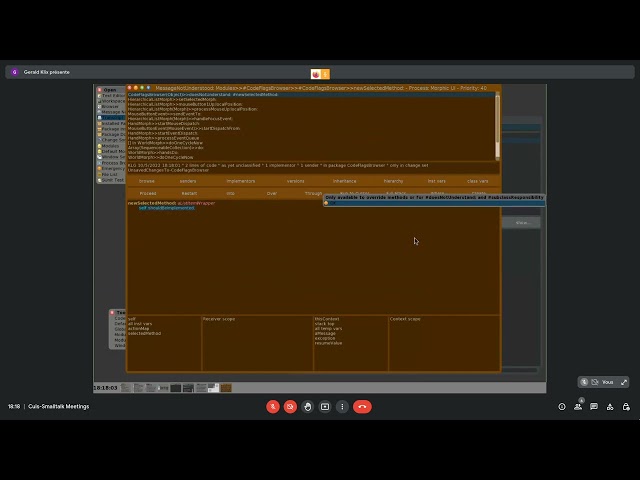
A Cuis based Smalltalk With Modules.
-
Dr. Geo
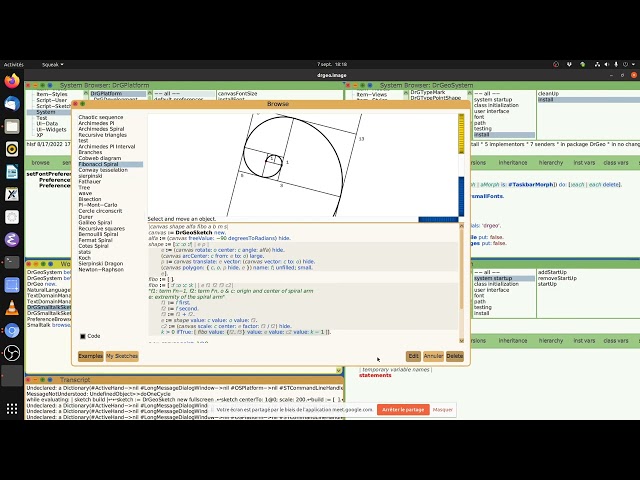
Interactive geometry. Short introduction to the objective and concepts. Demo.
-
Inline Refactorings and Unicode

Inline temporary and inline method refactorings, Fernando Balboa. Recent advances in Unicode editors and files, Juan Vuletich.
-
Bézier Curves

Manipulate Bézier curves with Morph through end-point and control-point handles to the HaloMorph.
-
Haver, Part I

A Cuis based Smalltalk With Modules.
-
LiveTyping
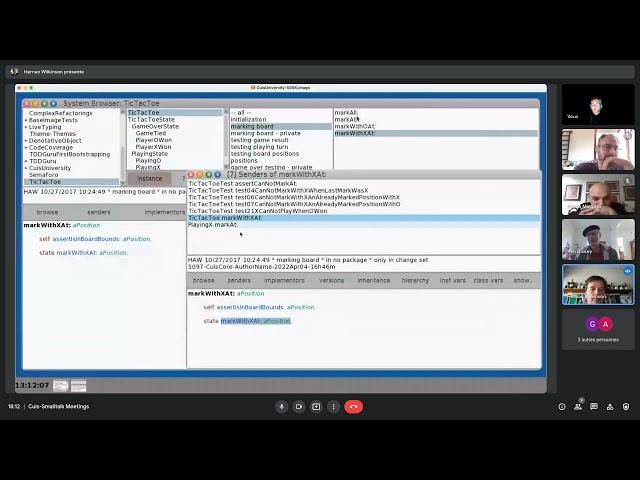
Automatic Type Annotation for Dynamically Typed Languages. Introduction to the concept. Possibilities. Demo.
-
UI Widgets, ARM and the Debugger

Cuis-Smalltalk-UI widgets, Hilaire Fernandes (not recorded). Cuis GUI running on ARM embedded with 5' touch screen, Nicola Mingotti. Debugger improvements, Nicolás Papagna Maldonado.